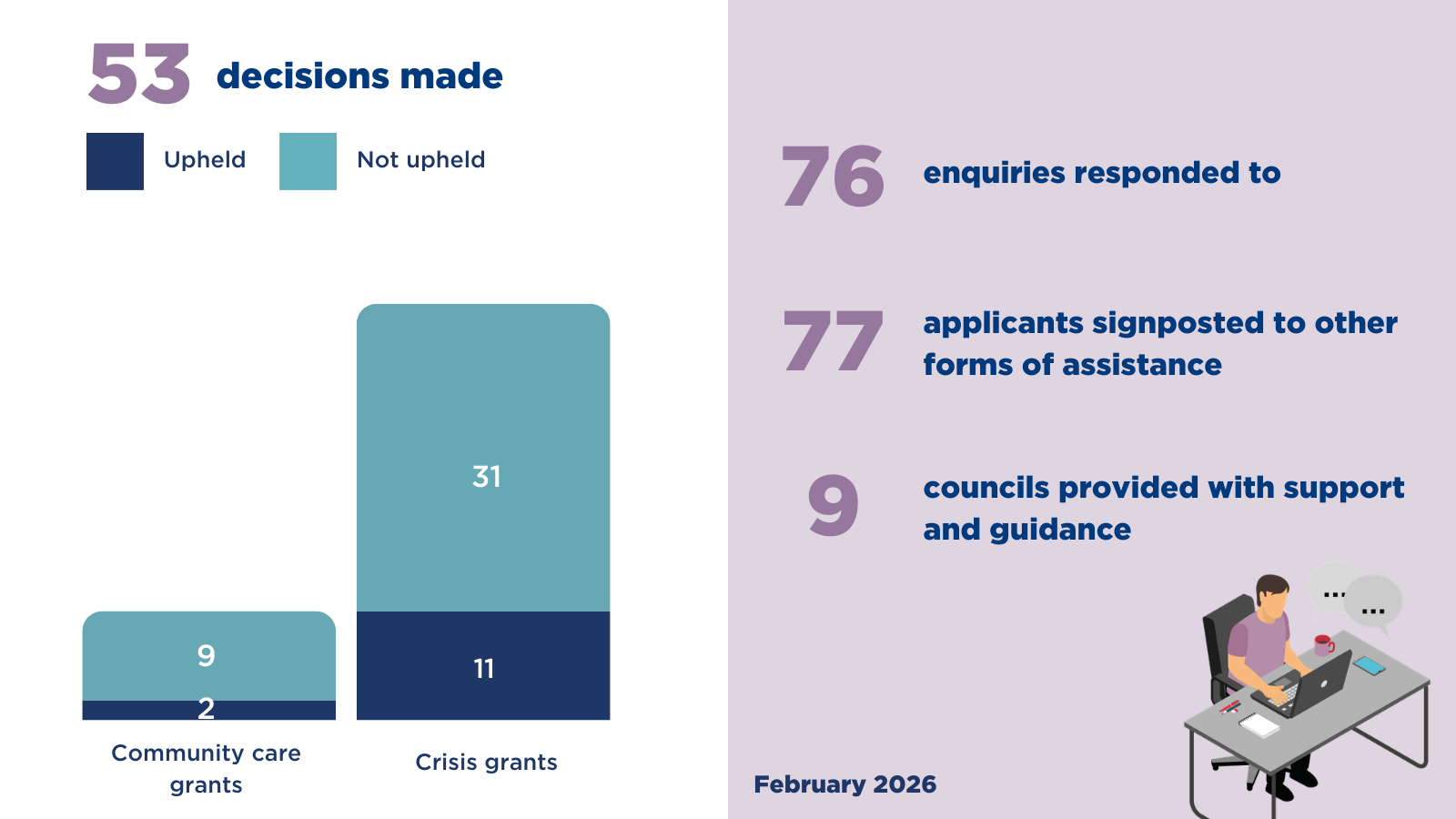
During January we
- responded to 76 enquiries
- made 53 decisions
- 11 community care grants
- 42 crisis grants
- upheld 2 (18%) of community care grants and 11 (26%) of crisis grants
- signposted 77 applicants to other sources of support. Of these, 68% had contacted us instead of their local council by mistake. A further 30% told us they were experiencing accessibility barriers when trying to contact their council, such as the lack of a freephone number, difficulties applying online or problems with council phone lines. The remaining callers got in touch too early in the process and were directed back to their local council for next steps
- received 9 enquiries from SWF staff within councils looking for guidance.
Engagement
As part of our work to raise awareness of the review process and make sure it is easy to find and access, we met with two councils this month. We explored the recent drop in review requests from their areas and discussed potential reasons. We also shared some suggestions for small website updates that could help make signposting to the review process clearer and easier for applicants to find.
Case studies
Savings and capital
C applied for a community care grant to replace soft furnishings in their home. C’s child had recently been diagnosed with a serious lung condition and had spent a month in hospital. C wanted to make the home as safe as possible before their child returned, as allergens had been identified as the trigger for the condition.
The council declined the application because they assessed that C had savings above the £700 limit and therefore did not meet the qualifying criteria.
During the review we looked at the council’s file and spoke with C. C explained that they had been advised to replace all soft furnishings before their child came home. We contacted the child’s consultant to confirm the medical advice, which was for a professional deep clean, not the replacement of all items.
We also noted that C had already purchased some items before applying and had bought additional items before the council reached its decision.
We found that C did not have savings over the £700 limit, as the council’s calculation incorrectly included backdated benefits that should not have been counted. However, the medical advice did not support the need to replace all furnishings, and we did not consider there to be exceptional pressure that would justify the purchases or meet the qualifying criteria.
Therefore, we did not change the decision.
Feedback for the council
- The savings calculation incorrectly included backdated funds, which resulted in an inaccurate assessment of C’s available savings.
You can find more case studies in the searchable case directory on our website.